| To paraphrase Ernest Hemingway, how do we achieve conservation success? Gradually, and then suddenly.
It’s certainly felt that way at our Xerces Society offices the past few weeks, as years of groundwork paid off with breakthrough achievements. A scientific study on pesticide residues in nursery plants inspired the creation of newly introduced legislation to establish a USDA pollinator-friendly plant label. And thanks to careful monitoring of insecticide sprays on public land by Xerces staff, residents of New Mexico were able to protect 25,000 acres of the Rio Chamas watershed. People everywhere are standing up for conservation, and we couldn’t be happier! |
|
| How Advocates Stopped Aerial Insecticide Spray on 25,000 Acres of New Mexico Natural Areas
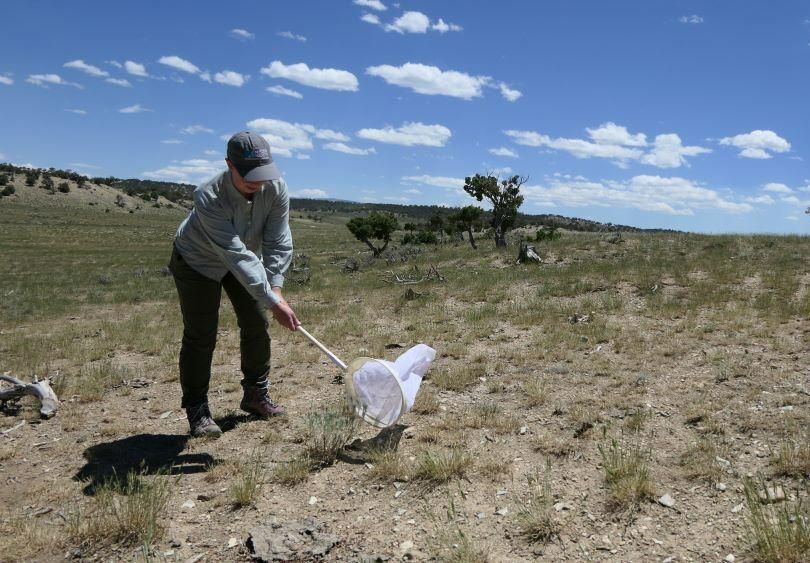
The wild and scenic Rio Chama River runs through a stunning landscape of lush green and sparse sagebrush. In early June, very few people noticed when the USDA-Animal and Plant Health Inspection Service (APHIS) posted a contract to treat 25,000 acres of public lands in the watershed with the insecticide carbaryl, starting as early as June 26. The target of the spray was native grasshoppers that sometimes compete for limited forage with cattle, mostly in degraded landscapes.
Carbaryl can harm a wide variety of insects including the many native bees and butterflies found in the watershed. It is also toxic to birds, fish, aquatic insects, and mammals and is considered a likely human carcinogen. Once staff at the Xerces Society sounded the alarm, a broad coalition of New Mexican residents sprang into action. Learn more |
|
| New Legislation Would Establish USDA Label for Pollinator-Safe Plants
Oregon’s U.S. Senator Jeff Merkley introduced new legislation that would create a pollinator-friendly plant labeling program, modeled after the Organic Foods Production Act that created organic labeling. The legislation follows research findings by the Xerces Society and University of Nevada, Reno that documented dangerous pesticide levels in pollinator plants at U.S. nurseries. Learn more |
|
|
| MONARCH Act Reintroduced to Aid Western Butterfly
United States Representative Jimmy Panetta (CA-19) and Oregon Senator Jeff Merkley (D-OR) recently reintroduced the House version of the bicameral Monarch Action, Recovery, and Conservation of Habitat (MONARCH) Act. The MONARCH Act would authorize $62.5 million for projects aimed at conserving the western monarch and an additional $62.5 million to implement the Western Monarch Butterfly Conservation Plan, which was prepared by the Western Association of Fish and Wildlife Agencies in January 2019. Learn more |
|
| Events
Southwest residents can now register for Farming with Soil Life on July 25 with Xerces agronomist Stephanie Frischie, specifically designed for the New Mexico/Southwest region. On July 27, join Jessa Kay Cruz and Kaitlin Haase for a webinar on how Xerces’ habitat kit program is removing barriers to successful restoration.
View all events |
|
| Xerces is a donor supported non-profit organization. Your tax-deductible donation today will help grow and sustain our essential work.
Join or Renew your membership today!
Start a fundraiser to protect invertebrates. |
|
|
Donation Mailing Address:
The Xerces Society
PO Box 97387
Washington DC, 20090-7387
If you need us, email us at membership or call us at 855-232-6639, option 2. |
|
| Banner photo: Kaitlin Haase, Xerces Society
Body photo: Angela Laws, Xerces Society
Copyright © 2023 The Xerces Society |
|
|
|
|
|







 North Carolina Small Farm Association